


New Publication! | Guardians or Sovereigns? The “Militant Democracy” Paradox in Constitutional Courts’ Electoral Practice
New Open Access Chapter on Constitutional Courts and the “Militant Democracy” Paradox
Published in the open access volume Constitutional Courts and Electoral Integrity, the chapter asks how far constitutional courts can go in defending democracy during elections without becoming sovereigns of the electoral process.
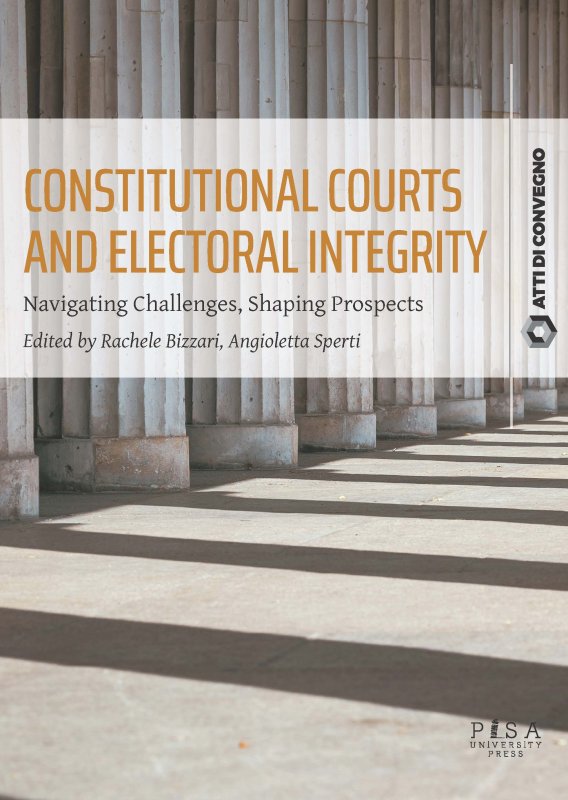
The chapter “Guardians or Sovereigns? The ‘Militant Democracy’ Paradox in Constitutional Courts’ Electoral Practice”, by Chiara Spiniello, has been published in Constitutional Courts and Electoral Integrity: Navigating Challenges, Shaping Prospects, edited by Rachele Bizzari and Angioletta Sperti (Pisa University Press, 2026).
Starting from Karl Loewenstein’s thesis on democratic self-defence, the chapter examines three modalities of constitutional court involvement in elections through the case studies of Romania (2024–2025), Italy (2014; 2017) and Poland (2006–2011).
Summary
Constitutional courts are increasingly drawn into electoral conflict, whether by correcting the architecture of electoral laws or, more controversially, by intervening in electoral processes themselves. The chapter asks how far such interventions may go when they are justified in the language of “militant” (or “protective”) democracy, taking as its point of departure Loewenstein’s thesis that constitutional legality can be exploited as a pathway to democratic self-destruction.
Through a “most-different” comparison – the annulment of the Romanian presidential election, the ex post constitutional correction of electoral engineering in Italy, and a more restrained, rule-focused review in Poland – it shows that safeguarding democracy through constitutional-court practice is a question not only of how far judges go (annulment, correction or restraint) but also of what they treat as the core of electoral integrity.
Courts as guardians, not sovereigns, of the electoral process
The chapter closes with three questions: the threshold of compromise – who decides when electoral competition has been altered so deeply that ordinary correction is no longer sufficient; the minimum effective remedy – annulment and suspension should remain ultima ratio; and the temporality of exception – emergency tools need time limits, sunset clauses and structured ex post review.
Its unifying thread is that electoral integrity is best protected when the legal order strengthens the conditions of fair competition without displacing the electorate as the ultimate source of democratic authority: courts are indispensable as guardians of constitutional boundaries, but they should not become sovereigns of the electoral process.

Comments are closed, but trackbacks and pingbacks are open.